Announcing the 2026 Biosphere Research Awards Recipients

This year, $46,000 was granted to three local organizations supporting impactful environmental research projects in the region.

Biosphere Research Awards Clayoquot Biosphere TrustPhoto credits: Whales of Clayoquot and Barkley

We deeply appreciate the efforts of the Research and Environment Advisory Committee, a group of dedicated local volunteers who carefully reviewed every application. To learn more about the projects below or to connect with a project leader, email colin@clayoquotbiosphere.org

Special thanks to Tofino Resort & Marina for generously contributing to the Biosphere Research Award budget this year through the Clayoquot Sustainability Fund.

2026 Biosphere Research Award Projects

Modelling Nearshore Habitat Suitability for Forage Fish on the West Coast | Project Watershed Society

Pacific sand lance are small forage fish that play a critical role in coastal ecosystems, serving as a key food source for seabirds, salmon, whales, and more than 100 other predators. Along the west coast of Vancouver Island, their spawning and habitat areas remain largely unknown, with very limited data available.

This project uses environmental DNA (eDNA), tiny genetic traces left behind in the sand, to detect the presence of sand lance in intertidal and shallow subtidal habitats. By combining these findings with data on sediment type, shoreline features, and ocean conditions, the project will develop a predictive habitat map identifying where suitable sand lance habitat is likely to occur. This tool will support communities, First Nations, and decision-makers in protecting important nearshore areas and making more informed choices about shoreline development and marine planning.

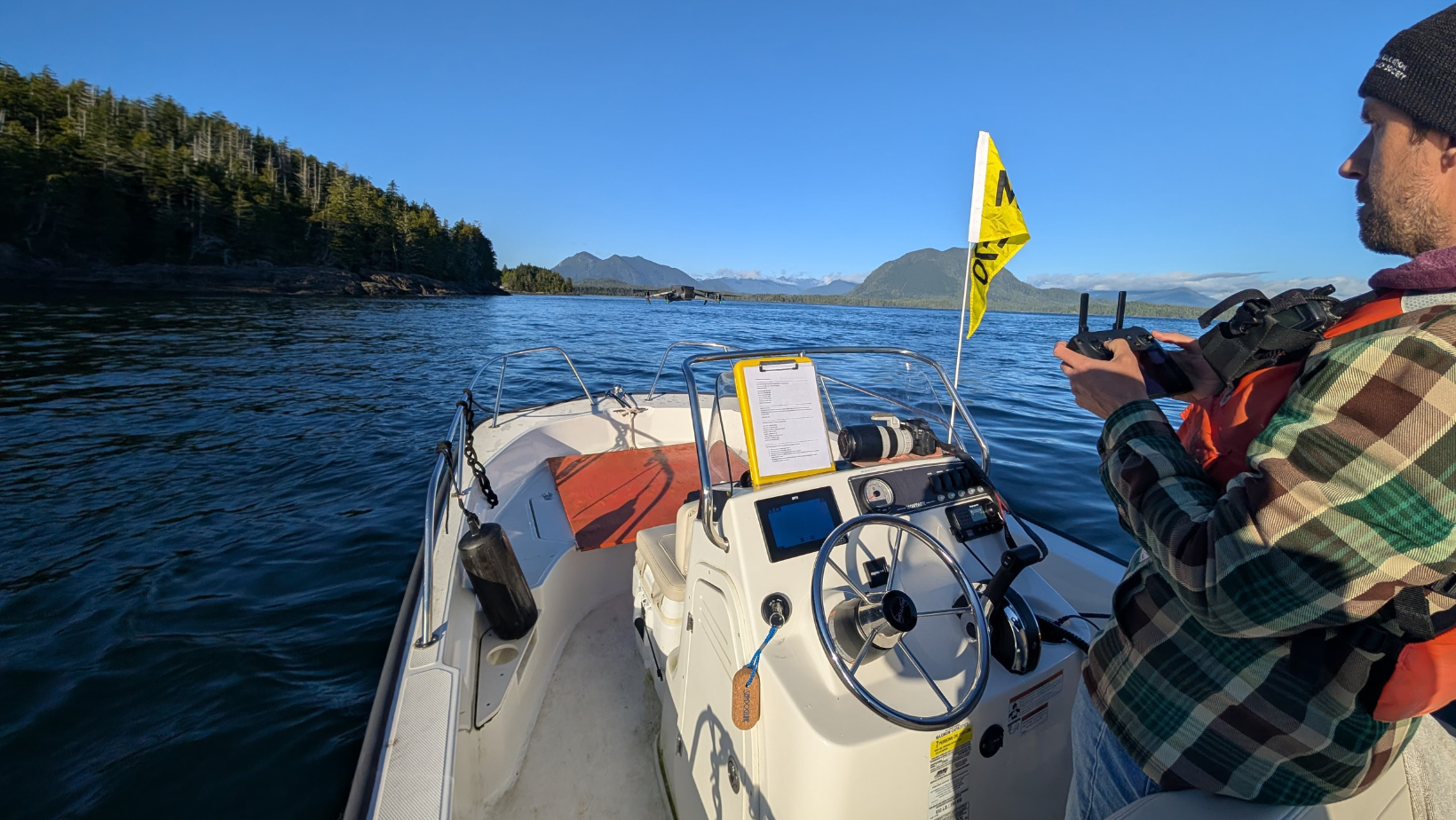
The FOG* Project: Grey Whale Drone Photogrammetry | Marine Education and Research Society

This project uses drone-based aerial imaging to safely measure individual whales and assess their body condition. These measurements are processed and used to calculate a Body Area Index, a key indicator of health. Over a three-year period, the project will track multiple whales across seasons to better understand changes in body condition, year-to-year variation, growth rates, and pregnancy. It will also provide insights into how whales use different foraging habitats. By focusing on the health and behaviour of known individuals, the project aims to build a clearer picture of how the Pacific Coast Feeding Group grey whales are doing in the region.

Wildlife Monitoring in ƛaʔuukʷiʔat hauułii | Nuu-chah-nulth Youth Warrior Family Society

This project monitors and maps wildlife movement and habitat use within ƛaʔuukʷiʔatḥ (Tla-o-qui-aht First Nation) territory by integrating community knowledge with spatial technology. Tribal Parks Guardians and community members provide observations on species activity and corridors to guide the placement of bush cameras. The ground-level data is then supplemented with drone surveys and LiDAR imagery to create 3D maps of forest structures and biodiversity hotspots. A key focus includes monitoring the Tranquil watershed to understand how industrial activity affects habitat integrity.

The goal is to provide ƛaʔuukʷiʔatḥ with empirical evidence to support Indigenous-led land-use decisions and strengthen the Nation’s capacity to protect and sustainably harvest key species. By involving local youth in technical training and field operations, they ensure that conservation skills and data ownership remain within the community, fostering long-term stewardship and informed management of the haḥuułii.

As both the local community foundation and the organization stewarding the Clayoquot Sound UNESCO Biosphere Region designation, the Clayoquot Biosphere Trust is proud to provide annual funding to local partners who are carrying out vital work that strengthens community well-being and supports the long-term health of ecosystems across the region.

Announcing the 2026 Research & Environment Grants Recipients

August 3, 2026
This year, $20,000 was awarded to four projects in the region. These projects address threats to key species and ecosystems and uplift nuučaan̓uł (Nuu-chah-nulth) ways of knowing. Efforts also focus on habitat conservation, restoration, and protection for ecologically and culturally important species and ecosystems.

Announcing the 2025 Biosphere Research Awards

September 4, 2025
We’re excited to announce the recipients of the 2025 Biosphere Research Awards! This year, the CBT has granted $38K to support three amazing projects. This funding stream supports initiatives that address key species or ecosystem threats, focus on reversing degradation trends, and promote conservation actions with broad application. Each program aligns with First Nations priorities and protocols, upholds the spirit of the UNESCO Biosphere designation, and shares research findings publicly. Read more!

Announcing the 2024 Biosphere Research Award

August 29, 2024
We are excited to announce the recipients of the 2024 Biosphere Research Award. This year, the CBT awarded $20,000 in funding to Ha’oom Fisheries Society for their Coho Vitality Project.

Announcing the 2024 Research & Environment Grants

August 29, 2024
We're excited to announce the recipients of the 2024 Research and Environment grants. This year, the CBT awarded over $36,000 in funding to six inspiring projects in the region. These projects address threats to key species and ecosystems and uplift nuučaan̓uł (Nuu-chah-nulth) ways of knowing. Efforts also focus on habitat conservation, restoration, and protection for ecologically and culturally important species and ecosystems.

Regional Forum

November 20, 2023
On Wednesday, October 18th, 2023 the Clayoquot Biosphere Trust facilitated a regional forum. Over 65 individuals convened virtually and in person on Tla-o-qui-aht territory at TinWis, fostering meaningful connections, sharing insights, and cultivating strong relationships. Participants included representatives from First Nations, local governments, organizations, businesses and individuals involved in environmental research, stewardship, restoration, and sustainable development.

Clayoquot Biosphere Project Storymap

March 24, 2022
We are excited to share an exciting new StoryMap that shares a foundational chapter in science and conservation history on the west coast of Vancouver Island. Back in the 1990s, west coast residents created a grass-roots environmental research organization called the Clayoquot Biosphere Project (CBP).

Clayoquot Sound Oceanographic Conditions: University of Washington Tacoma Study

June 30, 2021
Since 2017, the Clayoquot Biosphere Trust has collaborated with the University of Washington Tacoma to conduct ongoing water-quality research on the physical, chemical and biological oceanographic conditions in the fjords of Barkley and Clayoquot Sounds. UW Tacoma has been conducting this research in the region since 2000 and have a vast collection of data as a result. This partnership is mutually beneficial as it provides us with a broader knowledge of local conditions as well as giving the students real world data collection and analysis experience.

Reflections on the book "Communities, Conservation and Livelihoods"

April 22, 2021
The book Communities, Conservation and Livelihoods, edited by Anthony Charles, is an account of these community stories recently co-published by the Community Conservation Research Network and the IUCN Commission on Environmental, Economic and Social Policy (CEEP). When taken together, these community experiences demonstrate how each community in its own unique way has learned the value of working together when guided by shared conservation principles and partnerships for mobilizing support for local economic and ecological solutions.